ESSAY
Clearing the Fog on Capability (Part Two) — Shaping Human Capability
This essay is the second in a two-part series clarifying capability in organisational change management. Part One examined organizational capability through a framework of People, Process, Tools, and Data or Information. Part Two focuses on human capability and its connection to organizational capability. It introduces four interdependent components: Mindset, Knowledge Set, Skill Set, and Tool Set. The essay also shows how these appear across professional, paraprofessional, leadership, and everyday roles involved in managing organizational change, offering a practical foundation for developing change management human capability.
The Continuing Conversation
In Clearing the Fog on Capability (Part One), I distinguished between capacity and capability, introduced the notion there was a difference between organizational capability and human capability, and established a practical framework for understanding organizational capability through its four components: People, Process, Tools, and Data/Information. I also introduced the idea that any organizational capability, including change management capability, sits within a philosophical view, like how change is understood and practiced.
This second essay continues the conversation by diving more deeply into the idea of human capability. It examines how human capability lives within people, how it varies across different roles and levels, and how it connects to organizational capability Together, these ideas help practitioners and those they serve to shape capability-building that is both human and systemic.
Understanding Human Capability
Human capability describes what an individual or person is able to do. It is more than the sum of their skills or knowledge. It is a blend of what they believe, what they know, what they can do, and what they use to act effectively.
Drawing from Erik Stolterman and Harold Nelson’s work in The Design Way (2012), human capability can be described using two intersecting dimensions: thinking versus doing, and internal (to a person) versus external (to a person). These create four distinct interdependent components of human capability:
- Mindset (internal and thinking): what a person believes and the values, attributes, and orientation that shape how they see and engage with the world.
- Knowledge Set (external and thinking): what a person knows and understands.
- Skill Set (internal and doing): what a person can do through practice and experience.
- Tool Set (external and doing): what a person can use to extend or amplify their actions; at the human level this tends to focus on execution rather than management of a capability.
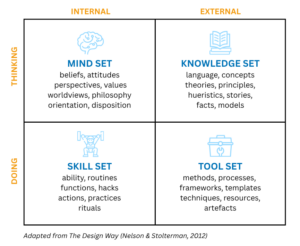
Together, these four components define not just what a person does but how and from where that doing arises. They provide a map for understanding human capability development as both separate and related components.
For sponsors or leaders commissioning human capability work, this framework helps make human development tangible. It illustrates that developing (human) capability involves more than training people in tools. It also requires nurturing mindset, cultivating knowledge, and developing skill. When all four are addressed, individuals become confident competent actors and agents for an organizational capability.
With this foundation, we can now examine what these components look like in the practice of change management.
The Professional Practice of Change Management
In professional change management practice, the four components of human capability take on specific content and depth for the roles of the professional practitioner.
In their practice, a professional practitioner might bring a Mindset of curiosity and empathy, a Knowledge Set that spans behavioural science, systems thinking, and anthropology, a Skill Set that includes facilitation, influence, and sense-making, and a Tool Set of frameworks and artefacts to apply these effectively.
Professional bodies such as the Association of Change Management Professionals (ACMP) and the Change Management Institute (CMI) have worked to define and substantiate the professional practice of change management. Their Bodies of Knowledge (for example, the CMBOK®) represent a strong attempt to establish a shared foundation for the Knowledge Set, though not its totality. Many methodologies contribute additional codified knowledge, and professional communities sustain a live discourse that reflects the evolving and uncodified aspects of the field’s knowledge. Their Competency Frameworks1 articulate a structured view of the Skill Set across a scale of professional practice. While methodologies such as Prosci®, Lean Change Management, and Agile Change Management contribute to the Tool Set.
What remains less defined is the Mindset. This component shapes how practitioners interpret organizational situations, exercise judgement, and hold ethics in practice. It is deeply personal yet profoundly influential. I explored this gap in The Missing Mindset (2019, Questo), where I argued that the professional field of change management would benefit from an explicit articulation of the shared mindsets to underpin ethical and effective practice. This is both a challenge and an opportunity for the field.
Scaling the Human Capability Framework across Multiple Actors
The human capability framework becomes even more powerful when we apply it not only to individuals generally, but to classes of actors who participate in change management in different ways. Instead of assuming a single universal profile of competence, this perspective recognises four distinct classes of actors, each with its own purpose, remit, and form of contribution.
Drawing on the human capability framework, each class occupies a horizontal plane. Every plane contains the same four components — Mindset, Knowledge Set, Skill Set, and Tool Set — but the content of these components differs according to how an actor participates in change management. This is the separateness factor that enables clarity about the unique nature of each class.
At the same time, the four components also run vertically across all classes. This creates a relatedness factor, revealing how each class draws on these components in interconnected but differentiated ways. It allows us to see coherence across levels of practice without collapsing their differences.
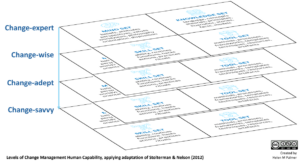
In change management, I propose that these four classes are:
Change-expert
These are the professional practitioners whose primary discipline is change management. Their work is grounded in deep experience, reflective practice, and advanced judgement. They hold substantial Mindset, Knowledge, Skill, and Tool Sets specifically shaped around the discipline. Their contribution is to interpret complex organizational change situations, guide others through changing, and maintain an ethical, human-centred focus in practice.
Change-wise
These are allied professionals such as project managers, business analysts, designers, or architects. Their own discipline is primary; however, they require a working grasp of change management so that they can anticipate impacts, accommodate the people dimension in their plans, and collaborate effectively with change-experts. Their Mindset, Knowledge, Skill, and Tool Sets around change management are intentionally lighter and more targeted to particular activities than those of change-experts.
Change-adept
These are leaders and managers with responsibility for others. Their need for change management capability emerges from their duty of care. They must help their people navigate organisational changes, enable local sense-making, monitor readiness, and support adoption. Their human capability for change management is focused not on delivering the discipline, but on applying its principles within a leadership context. This is what many refer to as “change leadership,” though often without a clear articulation of what capability it rests upon.
Change-savvy
These are individuals acting only on behalf of themselves. Every person within an organization is a change participant with personal reactions, emotions, and meaning-making processes. Change-savvy capability equips them to understand their own responses, participate constructively, and take agency within organizational changing. Change-wise and change-adept individuals also return to this class when attending to their own needs.
In another organizational capability, there might be different descriptions and a different number of classes.
Illustrating the Classes Through Human Capability Components
Each class expresses the four components of human capability in its own way. The underlying structure is the same, but the content within Mindset, Knowledge Set, Skill Set, and Tool Set reflects the purpose and remit of each class.
Consider the Knowledge Set as an example of this horizontal perspective within change management capability. A change-expert, working as a professional practitioner, may hold substantial theoretical knowledge drawn from systems thinking, organisational psychology, anthropology, or human-centred design. Their knowledge base is intentionally deep and wide because it supports complex diagnostic work.
A change-wise contributor, such as a Project Manager, may hold knowledge of people-related risk management, organizational communications within project contexts, and the value of stakeholder engagement. Their focus is integration: ensuring the project accommodates the people dimension without needing to master the full discipline.
A change-adept actor, such as a Team Leader, may hold practical knowledge about team dynamics, motivation, and local sense-making. Their knowledge is grounded in the lived experience of supporting their own people through organizational changes.
A change-savvy actor, participating only on their own behalf, may hold basic awareness such as recognising that emotional reactions to imposed change are normal, that curiosity helps, and that participation aids adaptation.
The same pattern appears in the Skill Set. The professional change-expert may demonstrate advanced facilitation, influence across complex networks, and nuanced diagnostic sense-making.
A change-wise contributor, such as a Service Designer, may use skills like active listening, understanding the impact of service experiences on those who will deliver them, and providing clear communication from the perspective of their discipline.
A change-adept Team Leader may apply empathy, coaching, and the ability to translate organizational messages into meaningful local guidance.
A change-savvy individual may rely on self-reflection, help-seeking, and peer support.
These examples show how each class draws on the same capability components while expressing them in very different ways. The four classes share a common structure, yet each holds a distinct pattern of depth, purpose, and scope.
Why Defining Classes Matter
Each of the classes have their own meaning and utility:
- For individuals, the framework provides language to understand what is expected of them and what is not.
- For educators, it clarifies the intended audience for different learning programmes and prevents over-teaching or misdirected content.
- For leaders and recruiters, it supports better decisions about who is needed for particular initiatives, what kind of capability they must possess, and how to assess it or develop it.
- For professional experts, it offers a structured way to manage stakeholder expectations and navigate the often-fuzzy boundaries between professions.
The Utility of this Ontological Framework of Classes
The value of such a structure extends beyond elegant categorisation. It offers practical utility in multiple ways.
It helps people organise and make sense of what they know.
Many practitioners experience confusion or overwhelm because they have no map to place their experience upon nor the capability of others. This framework gives them a stable reference point.
It calms emotional turbulence and reduces frustration.
Once people can see where they (and others) sit and why, anxieties about legitimacy, ownership, or “not knowing enough” often ease.
It illuminates gaps.
By making the structure visible, it becomes easier to see which components or classes are neglected in an organization and where human capability uplift is needed. Whether it is across a class, or through a component of mindset, toolset and skillset and knowledge set through all classes of actors.
It gives language to friction and enables useful discussion.
Many conflicts between project teams, leaders, and change management practitioners arise from mismatched expectations of what human capability each class should possess. This framework makes those differences discussable.
It supports grassroot creativity while maintaining coherence.
Local leaders and teams can adapt and innovate in ways that make sense for them, while still staying aligned to a stable conceptual framework that maintains organizational integrity. It also means that anybody doing capability building, can strategize what and where they really need to provide in terms of detailed directions.
It integrates other disciplines sensibly.
The framework allows the knowledge from other disciplines, say for example neuroscience, to be positioned meaningfully. The contribution can be acknowledged and appropriately tailored for different classes of human capability without conflation or overreach.
This multi-level perspective when applied to change management (or any other discipline), shows that human capability is not confined to professionals. It is a repeating structure expressed at different levels of sophistication across all four classes of actors. Seeing this continuum helps organizations define what “capable” means for each contributor and avoids unrealistic expectations that everyone needs professional-level expertise.
It also clarifies how each class contributes differently but meaningfully. In change management, change-experts bring depth, change-wise contributors bring integration, change-adept leaders bring local stewardship, and change-savvy individuals bring personal agency. These contributions are complementary rather than competing.
When organizations use this frame of reference, human capability-building in change management can become more targeted, development pathways can be more realistic and aligned to purpose, collaboration can improve, and friction reduced. It also reinforces that cultivating everyday change-savviness complements, rather than competes with, professional expertise.
Bridging Human and Organizational Capability
Human capability and organizational capability are distinct yet interconnected. Human capability lives within the People component of organizational capability, while the other components (Process, Tools, and Data/Information) enable or constrain it.
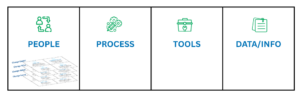
Within the People component, human capability is not simply a matter of having capable individuals present. It also involves making explicit the differing expectations placed on people across the organizational capability. The human capability framework and the innovative class-of-actors framework (applied to change management) introduced in this essay help articulate what kinds of mindset, knowledge, skills, and tools are appropriate for different participants by their remit and context. Thus, allowing human capability to be intentionally shaped rather than assumed as an organizational capability is developed.
A mature organization treats the four organizational capability components as interdependent. It shapes components that make good practice easier to enact, while also developing people who can work with skill and discernment. Building strong People capability without supporting structures leaves the organization vulnerable to inconsistency and loss when key individuals leave. Building strong Process and Tools without investing in People creates structures that look capable on paper but lack depth in practice.
The art of wise capability-building lies in strengthening both at once: human and organizational capability in tandem, each amplifying the other.
Building Capability that Endures
True capability-building is not a training program or a toolkit. It is a continuous act of investment in people and systems that sustain effective performance. Organizational capability belongs to the organization. It is embedded in structures, supported by systems, and reinforced through shared routines. It remains when individuals leave, forming part of the organization’s institutional memory.
Human capability belongs to the individual. It travels with them and influences every context they enter. When organizations invest in developing their people, they not only strengthen their own capability but also contribute to a wider ecosystem of capable individuals. These individuals, in turn, bring that capability to their families, communities, and society.
In this way, capability-building serves a dual purpose. It sustains organizational performance and enriches the broader social fabric of, in this applied case, change management literacy. A workforce that is both professionally capable and personally change-savvy is an asset not only to its employer but to society as a whole.
In Closing
This second essay explored human capability as something that is shaped through mindset, knowledge, skill, and tools, and expressed differently across those who participate in change management. It showed how these patterns can be made visible, discussed, and intentionally developed, rather than left implicit or assumed.
When viewed alongside organizational capability, human capability becomes easier to place and easier to steward. One gives structure and continuity. The other brings judgement, learning, and adaptation. Neither stands alone. Their relationship is what allows organizational capability to endure beyond individual effort or isolated initiatives.
Applied to change management capability, this perspective offers a way to move beyond fragmented development and unclear expectations, towards a more coherent and humane approach to building capability over time. It forms the conditions for change management capability to thrive at every level — professional, organizational, and everyday.
Clear language does not solve everything, but it enables the possibilities for better conversations. And better conversation is often where enduring capability begins.
1 Sidenote: I don’t think ‘Competency’ is fully synonymous with Capability. As explained in this essay, a Human Capability has Thinking aspects, not just Doing aspects. I think ‘Competency’ is synonymous with the Skillset component of a Human Capability.
——
A note about intellectual property and attribution
This frame of reference for organizational and human capability is applied in an emerging ontological framework for change management, called the Panoni Framework. This intellectual work has been developed by the author of this essay.
If you wish to apply, adapt, or reference this thinking in your own work, please use the following attribution:
Adapted from the Panoni Framework an ontological framework for change management, developed by Helen Palmer (2026).
Where appropriate, please also cite the relevant essay in this series as the source context for the application.
About the Author: Helen Palmer

New essays that we publish are announced in the Change Management Weekly™ delivered to your inbox weekly. Subscribe now so you don’t miss out!
Share with Your Colleagues

