ESSAY
Clearing the Fog on Capability (Part One) – Locating Capability in Organizations
This essay begins a two-part series on what capability means in organizational change management. The term is often used loosely, creating unclear briefs and expectations. Part One clarifies the difference between capacity and capability, organizational and human capability, and organizational change and change management. It introduces a simple framework for organizational capability using four components: People, Process, Tools, and Data/Information. Part Two (coming) turns to human capability, using Mindset, Skillset, Knowledge set, and Tool set to outline four levels of organizational change management practice.
The Nature of the Fog
There’s a word that echoes through meeting rooms and strategy documents in organizations with intentions for change management. Capability. It sounds solid and purposeful, doesn’t it? Yet in practice, it’s one of the foggiest terms in organizational discourse. People use it freely, often with confidence, and not always with clarity. That lack of clarity has real consequences because it muddies briefs, dilutes effort, and leaves organizational change practitioners unsure what exactly they are being asked to create, develop or support.
This essay is written primarily for change management practitioners but also for those who work with them. It aims to create a shared language that helps sponsors, clients, and other organizational change practitioners talk more clearly about what kind of capability is being built, where it lives, and who holds it. By doing so, it supports sharper scoping conversations, clearer remits, and more realistic expectations.
In an earlier essay Clearing the Fog on Organizational Change and Change Management, I explored how many practitioners conflate organizational change, a broad, multi-disciplinary field of how organizations evolve, with change management, the professional discipline that helps people adapt to and adopt scoped changes. The same kind of confusion now clouds conversations about capability. Before you can act wisely, you must know what kind of capability you are talking about and in which domain.
In this essay series, I expand on four clarifications that matter deeply for practitioners and their clients when designing, commissioning or contributing to capability-building work.
The four distinctions that matter most when you talk about capability are capacity versus capability, organizational capability versus human capability, organizational change versus change management, and professional expert versus other levels of practice.
By understanding these distinctions, we create the foundation for better conversations, smarter design, and clearer action.
Capability and Capacity are not the Same
It is not unusual to hear someone say: We need to build change capacity!
People often use the words ‘capacity’ and ‘capability’ as if they mean the same thing, but they describe very different qualities.
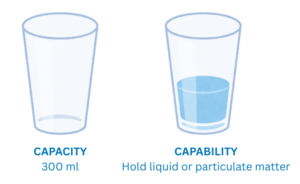
Capacity is about volume: the measure of how much of something can be held, produced, or absorbed. Capability is about ability: the property of what can be done.
Think of a glass. Its capacity might be 300 millilitres (10.5 fluid oz). That tells us how much liquid it can hold. Its capability is its ability to contain mass which could be liquid, or anything flexible enough to fit. Capability for a glass could look like holding water to drink, containing sand as a decoration, flowers as a vase — or even a candle as a stand!
When an organization says it needs more capacity, the first clarifying question should always be: Are we talking about capacity (the need for more of something, like time, people, or budget), or capability (the need for a better or different way of doing something)? Without that distinction, conversations about improvement and investment can quickly drift into confusion.
For practitioners, this is a moment to educate clients. Asking the simple question, “Do we mean capacity or capability?”, can transform a fuzzy brief into a meaningful dialogue about what actually needs to happen.
Why Clarity on the Domain of Capability Matters
Change management practitioners are often asked to “build change capability.” It sounds purposeful, even strategic. Yet it is as vague as being asked to “build exercise capability.” Would that be teaching someone how to walk, to establish a pattern of regular movement for wellbeing, or to become a professional athlete? And whose capability are we referring to — that of the organization, or of the people within it?
Before any design or planning begins, practitioners must determine the domain of the capability in question. Are you creating an organizational capability — a structured, repeatable way for the organization to manage changing — or are you developing human capability — the individual ability to engage with organizational changes, whether for self or to guide others?
There is further distinction to be made. Is it organizational change capability or change management capability? ‘Organizational change’ is a broad and unbounded concept, more philosophical in nature than practical. It incorporates many disciplines and professions, each with its own perspective on scope and purpose. (For more on this distinction see previous essay.) Organizational change capability would therefore be an enormous remit requiring significant investment and broad coordination. Change management capability, by contrast, is more specific. It focuses on the organization’s ability to help people adapt to and adopt changes well.
These distinctions are not mere semantics. They define the scope, the investment, the success measures, and the accountabilities of the work. Without them, practitioners’ risk being held responsible for outcomes they were never empowered to create, while sponsors lack clarity about what to oversee and bring about.
Let’s turn first to organizational capability (human capability is the focus on part two in this essay series).
Understanding Organizational Capability
An organizational capability is a way of describing what the organization can do consistently and in multiple places. It is not a department, not a team, not a role, and not a job title. It is a configuration of parts that, together, make something possible.
Organizations are made up of multiple organizational capabilities – sometimes called business capabilities. When these capabilities are organized in a coherent way, they create an operating model for an organization. In this essay I am only focusing on organizational capability as a single item, to show how it might be shaped for change management capability. If I were using an organizational change lens, it would make sense to take a higher perspective and explore how a collection of organizational capabilities that relate to each other, might be the vehicle for making changes, or even the target for changes to be made. That, however, is the topic of a different essay!
In business architecture terms, an organizational capability is an enduring ability of the organization to achieve particular outcomes. It is not merely a task or a function. It is a sustained and systemic ability made real through the coordination of four essential components:
- People – who enact and influence the capability; the roles, relationships, responsibilities, and expected agency.
- Process – what gets done and how it gets done across a lifecycle or value chain.
- Tools – what is used to support and enable the work, including templates, artefacts, and conceptual models at the collective ‘management’ level of work.
- Data/Information – what informs, fuels, and flows through the capability (inputs and outputs).
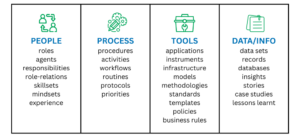
These four components form a practical framework to make tangible what an organization has the ability to do.
An organizational capability rarely maps neatly to a department. Its parts may live across teams or emerge through shared practice. Sometimes, such capability is housed within another function. For example, organizational change management might sit within a Project Management Office (PMO). What matters most is a shared understanding of its purpose and boundaries, so people know how and when to draw on it. When no natural home exists, a Centre of Excellence can serve as a focal point for knowledge, coherence, and improvement.
To have an organizational capability is to have coherence and coordination. It provides the glue that holds performance together across time and context. It is what allows an organization to act with consistency, not merely with effort. When viewed this way, capability is less about ownership and more about orchestration.
Applied for Change Management Organizational Capability
When we apply this lens to change management capability, the four components become clear:
- People include the actors and agents who guide and enable people through organizational changing and how they relate to each other. This can range from professional practitioners (Change Managers) to paraprofessionals (Project Managers or Business Architects), to change leaders (Sponsors, Executives, Team Leaders), and everyday personnel who may guide and enable themselves.
- Process includes the preferred change management methods, routines, and practices enacted by the roles above. It will often intersect with processes from other organizational capabilities such as project management, communications, and learning and development.
- Tools include selected methodologies, diagnostic tools, impact assessment templates, canvases and visualisation tools, human change and behavioural models and frameworks, knowledge repositories, feedback loops, communication channels, adoption metrics, and digital platforms that enable and support change management activity.
- Data/Information includes lessons learned, analyses of stakeholders, records of engagement activities, adoption progress datasets, organizational readiness indicators, and insights from adjacent fields such as neuroscience.
When working with clients, a practitioner can use this framework to help an organization see its organizational level of change management capability not as a department or role, but as a set of interrelated parts. Together, these parts determine whether the organization can consistently, though not necessarily uniformly, manage changing across initiatives and contexts.
Assessing Organizational Capability Maturity
The organizational capability framework above can be used when assessing capability maturity by integration with a Capability Maturity Model (CMM). A capability maturity assessment helps organizations understand how embedded, reliable, and repeatable an organizational capability truly is, beyond isolated examples of good practice.
The original Capability Maturity Model was developed in the late 1980s by the Software Engineering Institute (SEI) at Carnegie Mellon University to improve software development performance. It describes a progression through five levels of maturity, moving from ad hoc and individual-dependent activity to disciplined, defined, measured, and continuously improving practice. Since then, the underlying logic of the model has been adapted across many domains, including project management and, knowledge management.
Of interest to change management, the Change Management Institute (CMI) has promoted a particular capability model (c. 2012) and Prosci® has published their own capability maturity model.
The model advocated by CMI1 defined three core domains that together describe an organizational change capability: Project Change Management, Business Change Readiness, and Strategic Change Leadership. These domains reflect one coherent ontological perspective on how change management capability is distributed across delivery, preparedness, and leadership within an organization. A global survey was conducted in 2011 by CMI that provided an initial foundation for benchmarking capability maturity.
The Prosci® Change Management Maturity Model takes a different approach. It defines maturity in change management across the five levels. It addresses aspects of Leadership and Sponsorship, Application of Change Management, Competency, Standardisation, and Continuous Improvement. Together, these aspects focus on how consistently and effectively change management practices are applied across projects and sustained over time.
Even without access to a formal change management maturity model, the four-component organizational capability framework of People, Process, Tools, and Data or Information can be used alongside the five maturity levels to define and assess capability. Practitioners can map where strengths currently reside, identify uneven maturity across components, and use that insight to guide targeted investment rather than broad or unfocused initiatives.
Capability maturity is not about perfection. It is about consistency of intent, clarity of practice, and adaptability in execution over time.
Before turning to human capability (in part two of this essay series), it’s worth pausing on a philosophical note.
Philosophical Perspective of Organizational Change
An organization’s capability for managing change will always be shaped by its philosophy about what organizational change is and what managing change involves.
I offer a perspective here of my broad philosophical framework.
It is quite common to interpret the phrase “managing change,” by associating manage with command and control. That interpretation reflects a historical shift from its origins. The verb manage originates from the Italian maneggiare, meaning to handle or train horses, derived from the Latin manus, meaning hand. This earlier sense emphasised skilled handling, guidance, and working in relationship with a complex, living entity. From the seventeenth and eighteenth centuries, the term absorbed influence from the French ménage, referring to household administration, which gradually introduced associations of regulation and oversight. In this essay (and in my practice), managing change is used in its earlier, relational sense: stewarding and guiding changing experiences in human systems, not directing people as if they were machines.
Now to explain and give some nuance to the word “change”.
Organizational change practitioners, such as project managers, business architects, or service designers and organizational designers may reasonably see their work as managing change, that is change-the-noun: shaping intentional alterations to organizational structures, processes, systems, technologies, culture and ways of working. Their focus is on shaping what the organization is changing.
Change management practitioners, by contrast, focus on managing change, that is change-the-verb: how those object-level changes are encountered, interpreted, and integrated by people over time. This includes attention to sense-making, emotional and social responses, shifts in behaviour and identity, and the lived dynamics that emerge as individuals and collectives experience changing.
These aspects of managing change are distinct yet should not be inseparable. Organizational change practitioners focus on shaping the forms and artefacts of changes, while change management practitioners attend to how people engage with, interpret, and live through those changes in practice. For example, a co-design workshop about a new system both engages people in the process of influencing change-the-noun and becomes the means through which their changing experience is made meaningful (change-the-verb).
If the idea of philosophies of organizational change has piqued your interest you might start exploring with this book, Philosophies of Organizational Change (Smith & Graetz 2011).
The organizational capability framework described in this essay does not depend on any particular theory of organizational change. Whatever your current or emerging view about the nature of change, the four components of organizational capability (People, Process, Tools, and Data) can adapt and evolve accordingly. The value of this framework lies in its stability. It offers a coherent scaffold for describing what the organization can do, even as its methods, technologies, and philosophies evolve. It helps you hold structure while exploring, discovering, and evolving new ways of working including, for instance, the integration of AI-supported activity.
Looking Ahead
If organizational capability provides the scaffolding within an organizational system, human capability provides the energy and insight that animate it.
In Part Two – Shaping Human Capability, I will map human capability through the four-component framework of Mindset, Knowledge, Skill, and Tool, explore how it scales from professional to everyday practice, and connect it back to organizational capability. Continue to Part 2
1 The CMI model was the creation of the Carbon Group Change Consultants that was first published in the book, The Agile Change Methodology (Nahmias & Perkins 2012). This version of the CMM was called an “Organisational Change Maturity model”, rather than a Change Management Maturity model and the content of the model is broad enough to sit at the organizational change level rather than only the change management level.
——
A note about intellectual property and attribution
This frame of reference for organizational and human capability is applied in an emerging ontological framework for change management, called the Panoni Framework. This intellectual work has been developed by the author of this essay.
If you wish to apply, adapt, or reference this thinking in your own work, please use the following attribution:
Adapted from the Panoni Framework an ontological framework for change management, developed by Helen Palmer (2026).
Where appropriate, please also cite the relevant essay in this series as the source context for the application.
About the Author: Helen Palmer

New essays that we publish are announced in the Change Management Weekly™ delivered to your inbox weekly. Subscribe now so you don’t miss out!
Share with Your Colleagues

