Prefer to listen?
Listen to the audio-only version of this conversation.
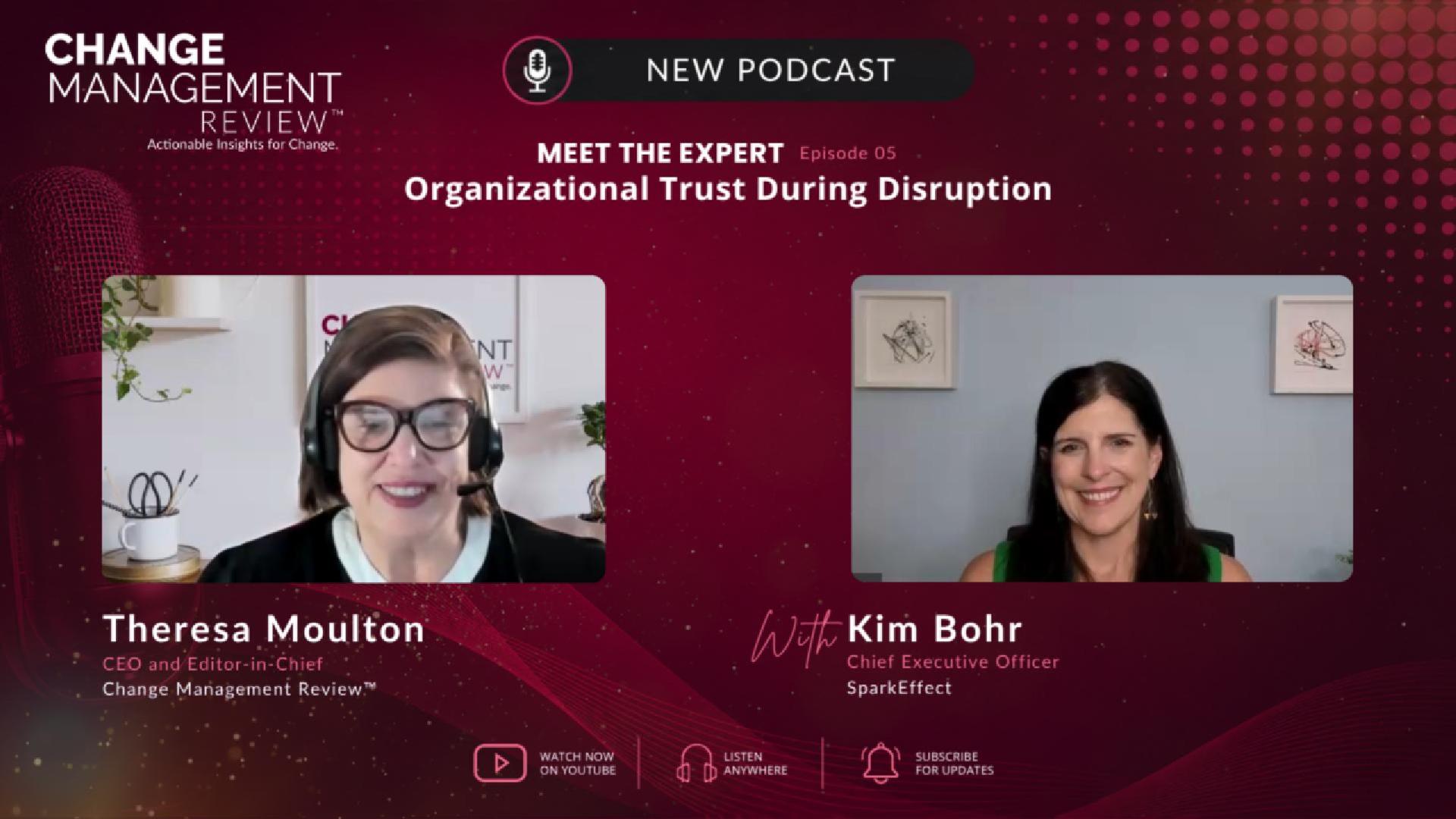
Organizational Trust During Disruption
with Kim Bohr
What happens to trust when an organization is navigating layoffs, leadership turnover, AI adoption, or other significant disruption?
In this episode of the Change Management Review™ Podcast, Theresa Moulton speaks with Kim Bohr, Chief Executive Officer of SparkEffect, about why trust should be treated as a strategic organizational capability, not simply a cultural aspiration.
Drawing on her experience advising executive teams and SparkEffect’s research into Trust Elasticity™, Kim explores how trust responds under pressure and what leaders can do to strengthen it during periods of disruption.
In this episode, you’ll discover:
- Why trust is not a “soft” issue, and how organizations can intentionally strengthen it.
- How disruption can actually strengthen trust when organizations navigate it well.
- What leadership behaviors matter most when employees are navigating uncertainty.
- Why asking employees to simply “adopt AI and figure it out” is not a sufficient organizational strategy.
- How leaders can approach AI adoption and organizational change with greater strategic clarity while keeping the human experience in view.
Guest Bio
Kim Bohr is Chief Executive Officer of SparkEffect, where she helps executive teams navigate complex disruption without fracturing organizational trust.
With more than 25 years of cross-functional leadership experience, Kim advises leaders on aligning strategy with human-centered practices that support organizational performance. Her work includes SparkEffect Trust Elasticity™, a research-based framework designed to evaluate and strengthen trust during periods of change, including AI integration, leadership turnover, and restructuring.
Kim’s perspective draws on her experience as a business executive, board advisor, adjunct lecturer, public speaker, and host of the Courage to Advance podcast. She is also the author of Successes, Failures & Lessons Learned.
New episodes of the Change Management Review™ Podcast Series are announced in the Change Management Weekly™, our digest of actionable insights for change delivered to your Inbox weekly. Subscribe now so you don’t miss out.
Share With Your Colleagues
Related Posts