Prefer to listen?
Listen to the audio-only version of this conversation.
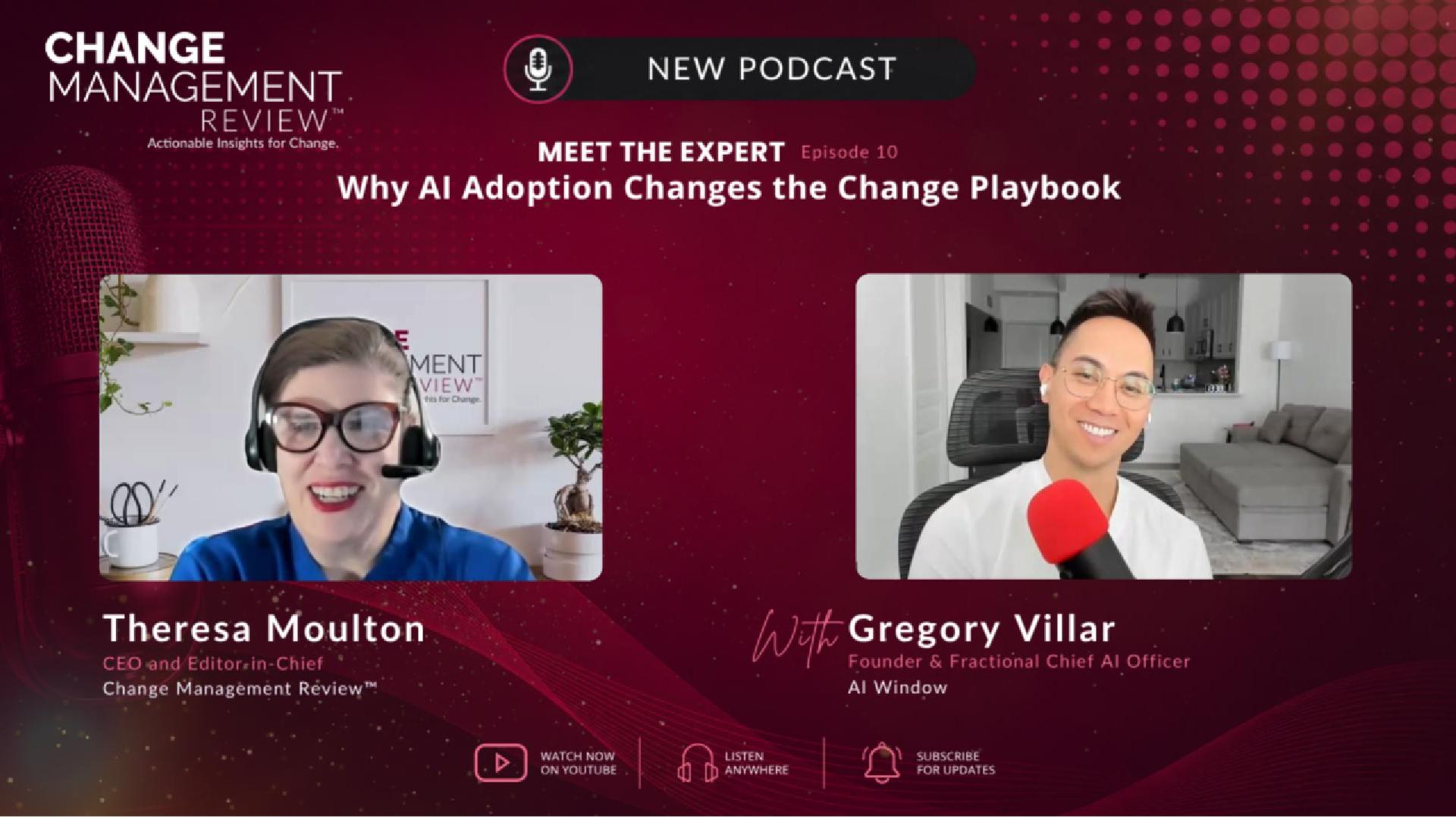
Why AI Adoption Changes the Change Playbook with Gregory Villar
What happens when the technology you are trying to adopt keeps changing faster than the organization adopting it?
In this episode of the Change Management Review™ Podcast, Theresa Moulton speaks with Gregory Villar, Founder & Fractional Chief AI Officer at AI Window, about why AI adoption presents a different kind of organizational change challenge.
Drawing on his experience helping organizations adopt AI at scale, as well as his background in systems engineering, Gregory explores why successful adoption requires more than introducing new tools or providing training. The conversation examines the temporary productivity dip that can accompany AI adoption, the importance of leaders modeling the behaviors they expect from others, and why organizations need practical ways to measure whether adoption is actually occurring.
The discussion also looks at the pace of AI itself versus the pace at which organizations can realistically change, and what that means for leaders and change practitioners responsible for helping people work differently.
In this episode, you’ll discover:
- Why AI adoption does not follow the same predictable path as a traditional technology implementation.
- Why organizations should expect a temporary productivity dip as people learn new ways of working with AI.
- How leadership behavior can influence whether employees actually begin using AI.
- Why measuring adoption matters more than simply assuming implementation has been successful.
- Why the speed of AI technology does not mean organizational adoption will happen equally quickly.
Guest Bio
Gregory Villar is the Founder and Fractional Chief AI Officer of AI Window, where he works with organizations adopting AI at scale.
Before founding AI Window, Gregory spent 14 years at NASA’s Jet Propulsion Laboratory as a systems engineer working on the Curiosity and Perseverance Mars rover programs. He later worked at Blue Origin on a lunar lander program before moving into entrepreneurship and AI advisory work.
Today, he brings a systems engineering perspective to AI adoption, helping leaders think more deliberately about implementation, measurement, organizational behavior, and what it takes for new ways of working to become established.